

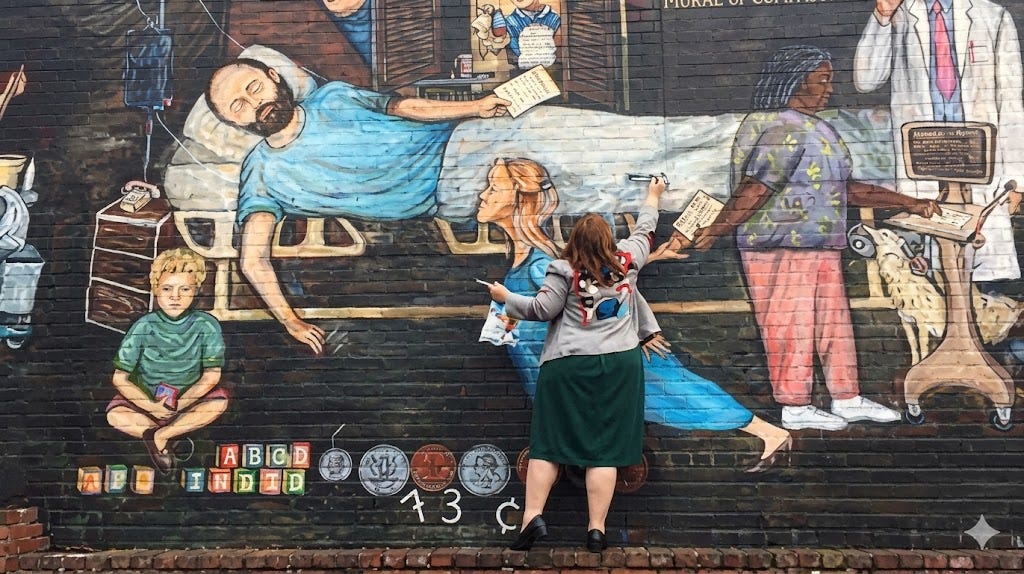
"73 Cents" by Regina Holliday
Hi everyone,
If you’ve been following my journey for a while—whether through the podcast, my discussions on financial independence, or my stories about hospice care—you know I don’t shy away from the hard truths about money, meaning, and mortality.
But there is one story I haven’t fully shared with you until now. It’s the catalyst behind my new book, The Healthcare Heist, and it’s about the exact moment I realized the American medical system was broken by design.
My medical career ended on an ordinary Wednesday evening with the ring of a doorbell.
My family, sitting quietly in the TV room merely feet away, had no idea about the cataclysm that had just overtaken me. When the process server handed me the summons for a malpractice lawsuit, I felt a brief moment of blissful disconnectedness before I plunged head-first into a dark abyss of burnout, self-doubt, and eventual anger.
What followed were four years of fear, anxiety, high-priced lawyers’ meetings, and eventual depositions for a case that was ultimately thrown out. The plaintiff’s attorney eventually admitted he never actually believed I had done anything wrong. I was just a connecting puzzle piece—a pawn to be exploited to extract a larger settlement from the hospital and nursing home.
I realized then that from the moment I entered medicine, I was destined to become an unwitting tool. We had become leverage in a lucrative maze of financial and power-based relationships that not only served to drive caregivers and patients apart but threatened to destroy our healthcare system in general.
This is something we talk about in the financial independence community all the time: following the money.
When you follow the money in American healthcare, the truth emerges. The lone survivors in this dystopian medical landscape are the corporations, venture capitalists, malpractice attorneys, bureaucrats, and other third parties who gain both wealth and power by hijacking our system. They have intentionally deployed a “divide-and-conquer” strategy, pitting doctors and patients against each other so no one notices that we are being robbed blind.
Instead of safeguarding the health and safety of Americans, the business of medicine has become a massive wealth transfer from citizens’ pockets and into the bank accounts of these large corporations.
I wrote The Healthcare Heist because we can’t afford to be pawns anymore. We don’t need to just change healthcare — we need to revolutionize it. And that revolution starts by bridging the “intimacy gap” between doctors and patients through the power of shared storytelling.
In the book, I pull back the curtain on the private equity roll-ups, the pharmaceutical price-gouging, the insurance denial tactics, and the medicolegal complex that is draining our wallets and our well-being. But more importantly, I offer a blueprint for how we—the actual patients and caregivers—can forge an unbreakable alliance and take the system back.
If you have ever felt frustrated, bankrupt, or abandoned by the medical system, this book was written for you.
The Healthcare Heist is officially available now. I would be incredibly grateful if you picked up a copy, read it, and joined the revolution.
Thank you, as always, for your support.
Jordan

Teaching a kid to ask "who profits from this?" about a bill or a subscription might be the most protective money skill there is.
The lawsuit didn't only attack your career. It attacked the memory of your own care.
That may be the quietest violence in the machinery. A clinical encounter is lived forward, under uncertainty, fatigue, partial knowledge, the ordinary imperfection of judgment. Litigation reads it backward, after the outcome is known, as if every ambiguity had always been a clue and every omission always evidence. So you are not only accused from outside. You are made to remember yourself through the grammar of accusation, to search your own past as if it were a crime scene. Four years of being taught to distrust the version of you that was trying to help.
That is where divide-and-conquer becomes intimate. It doesn't only set doctors against patients. It teaches each side to revisit a shared past through suspicion, to convert care, retroactively, into adversarial evidence.
Which is exactly why your remedy is not soft. In a system built on the backward reading, shared storytelling is the one act that refuses it: it returns the encounter to the forward grammar it was actually lived in, with both people inside it again. The theft was never only financial. It was the theft of a shared past, and storytelling is how you steal it back.