


We talk a lot in the financial independence community about the exit strategy. We obsess over high savings rates, cutting expenses, and pulling the ripcord on our careers the second we hit “The Number.” But lately, I’ve been wondering: Are we so eager to escape the bad that we are walking away from our potential to do something truly great?
In this week’s episode of Earn and Invest, I sat down with someone who forced me to look at this from the other side. Dr. Jaspal Singh is a board-certified pulmonologist, a critical care physician, and—above all—a lifelong friend. We were “gunners” together back in our intense college pre-med days, desperate to conquer the medical field.
But while I eventually chose the path of subtraction—stepping away from full-time clinical practice to focus on part-time hospice work—Jaspal went the other way. He chose expansion. He used our conversation to fiercely advocate for building a big, bold career and striving to be “in the room where it happens.”
Job vs. Career: Escaping First-Order Burnout
Jaspal’s early motivations were simple. Coming from an immigrant family where money was considered a luxury, financial stress drove him. But a grueling, mind-numbing summer working on an assembly line taught him an early lesson: he needed a career that would intellectually stimulate him, regardless of the paycheck.
As he navigated his medical training, his trajectory shifted from merely trying to reach the “next base” to tackling massive, systemic issues. He found traditional academic research unfulfilling and financially unstable, so he pivoted to clinical teaching. Eventually, he stared down what he saw as an existential crisis in healthcare: massive physician shortages in critical care. By pursuing a health administration degree and building telehealth and telerobotic programs, he transformed a side gig into a sprawling, impactful career.
During our conversation, we mapped out a crucial distinction that anyone looking to build a meaningful life needs to understand:
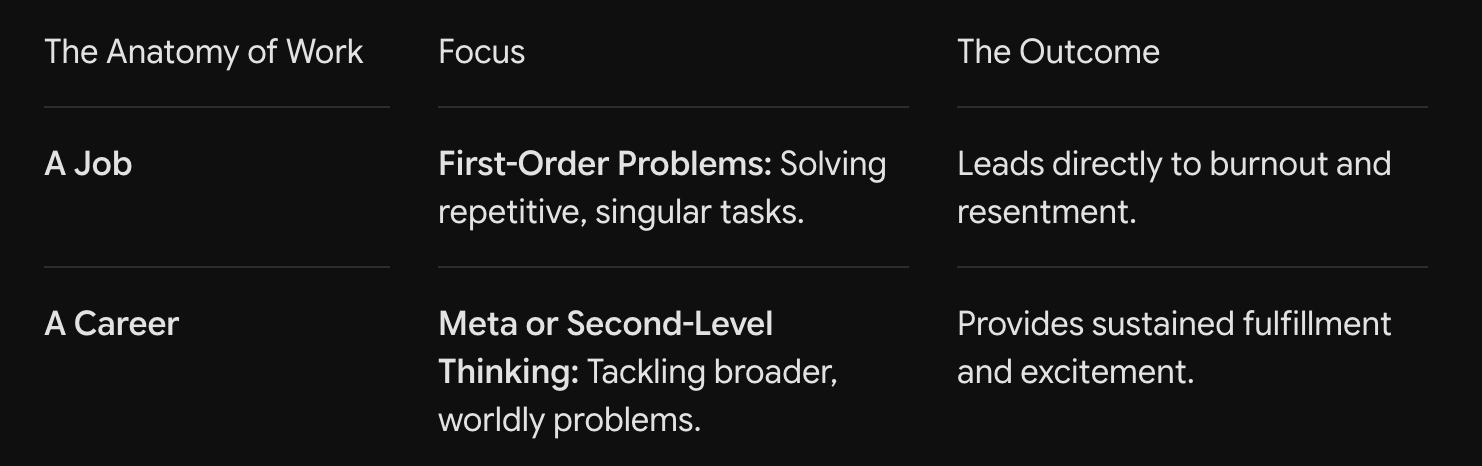
To build this kind of career, Jaspal adopted a philosophy borrowed from Richard Branson: Say yes to interesting opportunities, and figure out how to do them later. It’s an approach that led him to incredible opportunities—like running international conferences and traveling to Ukraine with a group of pulmonologists.
The Cost of a Big Life
I pushed back, of course. Saying yes to everything creates friction. It heavily strains personal time and family life.
Today’s younger generation is fiercely protective of their boundaries, putting up strict walls between their work and personal lives. But Jaspal and I found ourselves defending a counter-cultural truth: a blended, adventurous approach keeps the fire in your belly alive. Is there a cost? Absolutely. Jaspal openly shares the pain of missing moments with his wife and children. But his solution wasn’t to shrink his world; it was to actively involve his family in his work. Having his teenage daughters help run his international medical conferences didn’t just solve a scheduling conflict—it provided them with profoundly inspiring, real-world experiences.
But let’s be honest. Nobody gets through a massive career without some regrets. We talked deeply about the sacrifices:
Jaspal’s Regret: Wishing he had prioritized his personal health, sleep, and exercise earlier in his career—and admitting that the intense stress of the ICU often made him act in ways he didn’t like.
My Regret: Letting the immense stress of my early medical residency turn me into a colder, impatient person.
What is Your “Kill Switch”?
In the second half of the episode, I open up about a concept I think every professional needs to define: The Kill Switch.
A kill switch is a pre-determined, worst-case scenario that dictates exactly when you will walk away from your job. For me, that trigger pulled in 2014. I was hit with a frivolous medical malpractice lawsuit that dragged on for five agonizing years before the plaintiff’s attorney dropped me, admitting they only used me as leverage to secure a settlement against a nursing home.
That devastating experience was the catalyst for me leaving traditional medicine. It was my explicit sign to pivot, and I challenge my listeners to define their own kill switches—or at least recognize the softer triggers indicating it is time to walk away.
In the After-Show: Breaking the Silence
Stick around for the after-show, where Jaspal and I reflect on the medical field’s toxic culture of shaming doctors who care about financial wellness.
And, in a twist that genuinely caught me off guard, Jaspal turns the tables on me. Knowing my personality, he strongly encourages me to consider going back to school for an MBA, insisting I would deeply enjoy the structured reading assignments and the rigorous, university-level discourse with my peers.
Whether you are trying to find the exit, or trying to find the courage to build something massive, this episode is a roadmap for navigating the tension between ambition and lifestyle.